

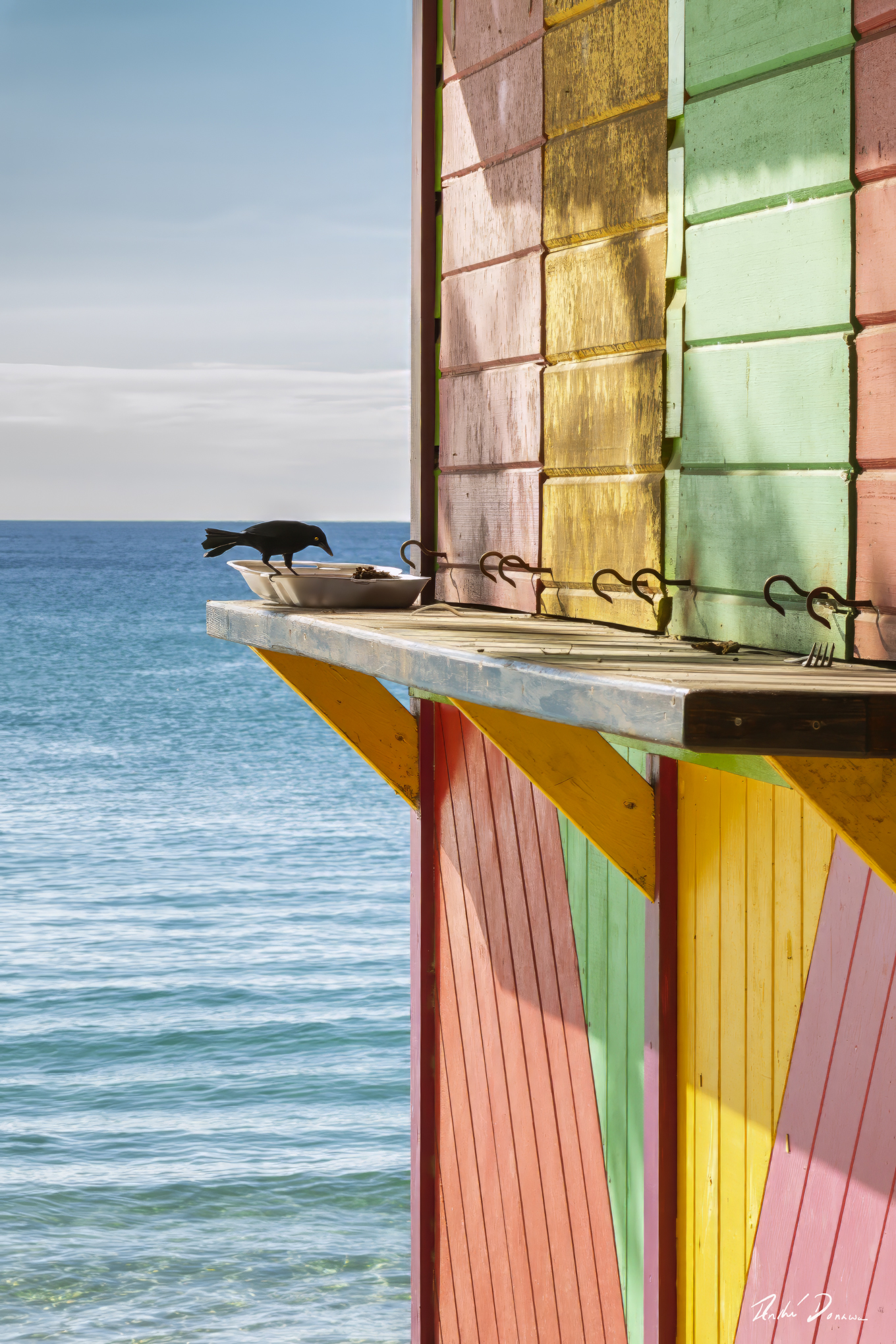
No Fork Needed – Original

No Fork Needed – Cropped
To Crop Or Not.
The subtle decision that shapes every photograph
There’s a moment in every photographer’s process where a simple question comes up:
Do I crop this… or leave it as it is?
It sounds like a technical choice.
But in reality, it shapes how we see, what we include, and what we leave behind.
Cropping Begins Before the Camera
Cropping doesn’t start in editing.
It doesn’t even start when we raise the camera.
It begins earlier.
The moment something catches our attention.
A line of light, a wave, a figure, we isolate it from everything else around it.
In that instant, we’ve already made a decision.
We’ve taken a crop of reality.
The viewfinder simply formalizes that choice.
What Cropping Really Means
At its core, cropping is the act of removing parts of an image.
But creatively, it’s about:
- Simplifying what the viewer sees
- Directing attention
- Clarifying intention
It’s less about cutting things out…
and more about revealing what matters.

Beach House – Uncropped

Beach House – Cropped
How I Approach Composition
When I’m shooting, I tend to set up what feels like the ideal composition,
and then give it a little room to breathe.
I leave space around the edges.
Not excessively, but just enough.
Because sometimes, in the moment, you miss something:
- A subtle distraction at the edge
- A slight imbalance
- Or an opportunity to refine later
That extra space gives me flexibility
without relying on cropping to fix the image entirely.
Why We Crop
Cropping serves multiple purposes:
- To improve aesthetics
- To focus attention
- To simplify the frame
- To support commercial needs (formats, layouts, client use)
- To strengthen the narrative
A small adjustment can shift how an image is read entirely.

She Dreams – Uncropped

She Dreams – Cropped
Cropping and Storytelling
A wider frame gives context.
A tighter crop creates intimacy.
The same image can tell different stories depending on what you choose to include.
Cropping becomes a way of asking:
What do I want the viewer to feel first?
The Evolution of My Cropping
When I first started, my approach to cropping was instinctive.
I wasn’t thinking about standard ratios.
I wasn’t thinking about print.
I was simply asking:
What looks right to me?
At one point, I even explored the idea of cropping into unconventional shapes like, circles and triangles, searching for something that felt more expressive.
But as I began printing my work, I ran into a different reality.
Most print labs work within standard aspect ratios.
And while custom options exist, they often come at a higher cost.
That experience shifted my thinking.
Cropping wasn’t just about personal expression anymore,
it also had to consider how the work would live in the real world.
Aspect Ratios and Practical Constraints
Not all crops are equal outside the screen.
- Standard ratios are easier and more affordable to print
- Custom ratios can limit accessibility
- Different platforms favor different formats
So sometimes, cropping becomes a balance between:
creative intention and practical outcome

A Swell Time – Uncropped

A Swell Time – Cropped
Cropping Across a Body of Work
Cropping also plays an important role beyond individual images.
When presenting a series or collection, consistency matters.
Images can feel more cohesive—and the narrative stronger—when they share:
- The same aspect ratio
- Similar sizing
- A unified visual rhythm
In this context, cropping becomes less about a single image
and more about how the images speak as a whole.
In-Camera vs Post-Processing
There are two other places where cropping happens:
In-Camera
- Intentional framing
- Stronger discipline
- Closer to the original vision
Post-Processing
- Refinement
- Flexibility
- Adaptation to final use
Photographers like Henri Cartier-Bresson were known for precise framing, often avoiding cropping altogether.
That approach trains the eye.
But modern workflows allow room for adjustment.
The key is knowing why you’re making the change.
Learning Through Cropping
Cropping can also be a teacher.
By experimenting with different compositions from the same frame, you begin to see:
- What strengthens an image
- What weakens it
- And how small changes affect the overall balance

In Pastel – Uncropped

In Pastel – Cropped
The Evolution of My Cropping
When I first started, my approach to cropping was instinctive.
I wasn’t thinking about standard ratios.
I wasn’t thinking about print.
I was simply asking:
What looks right to me?
At one point, I even explored the idea of cropping into unconventional shapes like circles and triangles, searching for something that felt more expressive.
But as I began printing my work, I ran into a different reality.
Most print labs work within standard aspect ratios.
And while custom options exist, they often come at a higher cost.
That experience shifted my thinking.
Cropping wasn’t just about personal expression anymore,
it also had to consider how the work would live in the real world.
Aspect Ratios and Practical Constraints
Not all crops are equal outside the screen.
- Standard ratios are easier and more affordable to print
- Custom ratios can limit accessibility
- Different platforms favor different formats
So sometimes, cropping becomes a balance between:
creative intention and practical outcome
Cropping Across a Body of Work
Cropping also plays an important role beyond individual images.
When presenting a series or collection, consistency matters.
Images can feel more cohesive, and the narrative stronger when they share:
- The same aspect ratio
- Similar sizing
- A unified visual rhythm
In this context, cropping becomes less about a single image
and more about how the images speak as a whole.
In-Camera vs Post-Processing
There are two other places where cropping happens:
In-Camera
- Intentional framing
- Stronger discipline
- Closer to the original vision
Post-Processing
- Refinement
- Flexibility
- Adaptation to final use
Photographers like Henri Cartier-Bresson were known for precise framing, often avoiding cropping altogether.
That approach trains the eye.
But modern workflows allow room for adjustment.
The key is knowing why you’re making the change.
Learning Through Cropping
Cropping can also be a teacher.
By experimenting with different compositions from the same frame, you begin to see:
- What strengthens an image
- What weakens it
- And how small changes affect the overall balance
My Perspective
In my work, cropping isn’t just about correction.
It’s about alignment.
There are images that feel complete the moment they’re captured,
and others that come into focus through subtle refinement.
The goal isn’t perfection in-camera or perfection in editing.
It’s creating an image where:
a moment is felt, not just seen.

In Awe – Uncropped

In Awe – Cropped
Final Thought
Cropping sits between instinct and intention.
We begin cropping the moment we choose what to look at.
The camera refines it.
And sometimes, editing completes it.
So the question isn’t just:
To crop or not?
It becomes:
When does the image feel complete?
Join the Conversation
Do you aim to get everything right in-camera,
or do you embrace cropping as part of your process?